
Random
Did that shuffle button really truly “randomize” your playlist? Five Taylor Swift songs in a row say no, but the truth is more complicated — and random — than your brain wants to believe. This is GalaxyQ #005.
Hey there.
This is GalaxyQ #005.
We’ve got a couple of random questions for you: When was the last time something happened to you that was actually random—and how would you even know? Or if a coin came up heads ten times in a row, would you bet the next flip is tails? (The honest answer is the whole issue.) If your shuffle plays the same artist twice in a row, is it broken—or are you?
In the A block, Justin McLachlan takes on a tour of randomness and why we were all deeply suspicious of Spotify’s “randomly” shuffled playlists, why hot hands sort of exist in basketball and sort of don’t, why the p-value is anything but significant, and why, ultimately, the random noise in our brains is necessary — for everything.
In the B block, we treat you to everyone’s favorite topic, math! But it comes with a deck of cards and something truly, truly unique, so we think you’ll love it. In the Arcade, we’ve got a guide to making your own dice, spectacular decks of cards that will help you out when you read the B block, and a desktop demonstration of pure randomness that comes from almost a century ago, but still captivates.
Finally, we’ve got a random game you can play at your local pub, and another of our own invention you can play all by yourself or with a friend, your choice. That’s all for now. We hope, after this issue, you’ll embrace the chaos of a truly random world.
With love,
The Editors.
The Tyranny of the Shuffle Button
by Justin McLachlan
After years of speculation, conspiracy theories, and utter contempt for "random" playlists that seemed to play the same Taylor Swift song twice in an hour — if you're the kind of person who listens to Taylor Swift — Spotify finally came clean in November 2025. It was a strange vindication, because it turned out the shuffle button was really, really, honest-to-God random. And that was exactly the problem.
For five years, the company had used a respected algorithm, the Mersenne Twister, to scramble playlists. The math behind it, Spotify's engineers said, was sound. But the math and the truly random playlists it produced were not what listeners wanted. What they wanted was the feeling of randomness, which is a different thing entirely, and a great deal harder to deliver. "True randomness," Spotify's product director for personalization told TechCrunch, "can be clumpy." Five heads in a row can be a valid random coin flip sequence. So can three songs by the same artist in five minutes. The math for randomness is right; the feeling we get from it, though, feels wrong.
So, in response to our years of collective complaints and conspiratorial grumblings, Spotify made shuffle less random. The new default mode generates hundreds of possible orderings every time you press play, scores each one for "freshness" against your recent listening, and serves the version that least clusters the songs you just heard. The dice are still rolled, so to speak, but now they're biased. The roll that wins is the one that, to a human ear, sounds or looks most like what a random die should be, even if it's anything but. Spotify's discovery — that true randomness doesn't seem random to human brains — is not so much a discovery as a rediscovery. The same problem has been turning up across modern life for at least a century. Engineers, statisticians, game designers, generals, doctors, and casino architects have all encountered it independently and developed various solutions. The problem, at its core, is that randomness, true randomness, is — to a human — not what we want it to be.
Randomness is the absence of pattern — the state in which no event tells you anything about the next one. Coin flips. Radioactive decay. The arrival times of cosmic rays. By definition, there is no story to be told about something truly random, and this is exactly what human minds are constitutionally unable to accept. We are pattern-recognition machines. The cost of failing to spot a real pattern — a stalking predator, a poisonous berry — was historically much higher than the cost of seeing one that wasn't there. Evolution loaded the dice in our brains toward over-detection. We are descended from the ancestors who flinched at every rustle in the grass, not the ones who calmly tallied the base rate (maybe because their under-reaction statistically made them more likely to be eaten by tigers and less likely to pass on their calm, under-reacting genes).
The result is that we cannot look at genuine randomness without generating a narrative to explain it. This happens automatically, and it's difficult to turn off even when we try. Random streaks become hot hands. Clusters become targets (or conspiracies). Coincidences become fables. And when we are wrong about the pattern — which is often — we still act on it anyway. The gap between true randomness as it exists and randomness as humans can tolerate is one of the most consequential and under-examined features of how we live.
Consider basketball. For thirty years, the canonical answer to "is the hot hand real?" was no. In 1985, psychologists Thomas Gilovich, Robert Vallone, and Amos Tversky published a paper showing that streak shooting was a cognitive illusion. Players and fans saw runs because human brains hallucinate them. It became one of the foundational findings of behavioral economics — proof that the mind manufactures patterns where none exist.
But that wasn't the end of the story. In 2018, the economists Joshua Miller and Adam Sanjurjo, writing in the journal Econometrica, showed that the original 1985 analysis had contained a subtle bug in how conditional probability behaves in short sequences. They found that if you count only the shots taken right after a streak of three hits, the math itself tilts the result toward "miss" even when the player has no hot hand at all. Correct for the bias, and a small but real hot hand reappears in the original data. Around the same time, separate research using newer datasets showed that when a player goes hot, defenders adjust — covering tighter, forcing harder shots — and this defensive pressure masks part of the effect in the box score. The streaks were partly real, the math was partly hallucinating their absence, and the defense was partly hiding what remained. Each side of a thirty-year argument was wrong in a different direction, and that is the strange shape this kind of mistake tends to take. It is not that humans see what isn't there. It is what is there that is harder to see clearly than anyone expected, from any angle — human or mathematical.
The cost of misreading randomness can be high, much higher than the stakes in a basketball game. In the summer of 1944, German V-1 cruise missiles — primitive jet-powered drones, the first true cruise missiles, carrying explosive warheads — began falling on London. Residents quickly noticed that certain neighborhoods seemed to be hit while others were spared. The clustering looked deliberate. People concluded the bombers must be aiming. So they moved. They built shelters in particular places, hoping to avoid the clusters. They made consequential decisions about where to put their children to sleep, based on the inferred intentions of an enemy on the other side of the Channel and on some apparent pattern.
After the war, an actuary named R. D. Clarke, who had spent the war in military intelligence, published a short paper that overturned conventional wisdom about the bombings. Clarke divided the bomb map of South London into 576 small grid squares, counted impacts in each, and compared the resulting distribution to a Poisson distribution — essentially the mathematical shape random, independent events make when they pile up in space. If the V-1s were being aimed, the real distribution should look nothing like a Poisson curve. If they were effectively falling at random, it should fit one almost exactly. You can guess what happened. The V-1 bombing pattern fit a Poisson distribution almost exactly.
The V-1's guidance system was crude enough that, for practical purposes, they couldn't be aimed with the precision Londoners divined. The impact map was essentially indistinguishable from darts thrown at the city by a blindfolded hand. There was no targeting strategy to outsmart. The clusters were the ordinary lumps that true randomness produces; the spared neighborhoods were the ordinary gaps between randomness and our pattern-making minds. People did not merely misperceive the pattern. They acted on the misperception at scale in ways that shaped where families lived and slept during the most dangerous summer of the war. The geography of wartime London was partly designed by a statistical, human-generated illusion.
A slower-rolling version of the same illusion has been running, with more paperwork, through modern science. The p-value — the famous threshold of 0.05 that decides whether a study counts as a "significant" finding — is, in its way, a tool for managing randomness. It asks: if there were really no effect here, how often would the data we observed turn up by sheer chance? Below one time in twenty, the convention says, you may declare a finding of significance. The threshold was set by the statistician Ronald Fisher in the 1920s as a working rule of thumb, but one never derived from any first principles or evidence of its importance. But over the course of a century, it became the gatekeeper of what counts as truth in the social and biomedical sciences.
What no one has fully reckoned with is what happens when you use that gatekeeping value at a modern scale. Run twenty honest experiments on nothing at all, and one of them will produce a "significant" result by construction. Now imagine an entire scientific field with thousands of researchers, each running many tests, each with career- and publication-biased incentives to find significance somewhere. The 0.05 sieve catches exactly the false positives that most closely resemble real discoveries. A landmark 2015 effort to replicate 100 prominent psychology studies found that, while 97% of the originals had been "significant," only 36% of the replications were. Later analyses found similar patterns in medicine, economics, and biology. A statistical artifact, properly narrated, becomes a discovery, becomes a textbook, becomes a treatment — despite being an illusion. Today, the replication crisis is often told as a story about fraud or sloppiness, but it is more a story about a culture that built its main quality-control mechanism on a single arbitrary threshold. We constructed a machine for managing randomness and, by accident, turned it into a machine for laundering it.
If this all sounds like a parade of failure, consider where the problem has been most thoroughly solved. Not in science. Not in war. But in games. The designers of video games figured out, sometime in the mid-2000s, that true randomness is intolerable to players just like true randomness ruins our playlists. If an ability says "25 percent chance to land a critical hit," and a player misses six in a row, they will understandably not break out a calculator and do the math to figure out that the game's randomness function is working. They will conclude that the game is broken, or that they are cursed, and they might even stop playing. The solution, pioneered in games like Dota 2, is called pseudo-random distribution. The chance starts lower than advertised — perhaps 8 percent on the first attempt instead of 25 — and rises with each miss until a hit lands, at which point it resets. Over thousands of attempts, the average rate matches the advertised 25 percent. But in any short sequence, runs of six misses or six hits become vanishingly rare, keeping pattern-making players (and spectators) happy. The math is bent against the kinds of streaks that pure randomness produces, because pure randomness, in human minds, feels like betrayal.
This idea has matured into a small body of design principles. The "pity timer" in gacha games guarantees a rare drop after a certain number of failed pulls. Roguelike games like Hades and Slay the Spire calibrate their reward distributions so that no individual run goes too long without something useful. The polite name for all of this is "calibrated randomness." It's the same insight Spotify eventually arrived at, two decades late: real randomness, fed straight to humans, feels broken and wrong. So you bend it until it feels right. What is striking, once you start collecting these examples, is how much of civilization consists of small interventions in the randomness gap our minds create. Casino floors are designed around it. Gambling regulators police it. Clinical trial protocols are constructed to defeat the kinds of pattern-narration that turned the replication crisis into a slow-motion disaster. Jury selection involves randomization procedures that are carefully designed to appear fair. Even slot machine chimes are tuned, partly, to soothe a human brain that would otherwise rebel at long stretches of nothing.
There is one machine that runs on raw, uncalibrated randomness — that, in fact, cannot function without it — and we carry it around inside our heads. Cortical neurons, the cells that do most of our thinking, fire irregularly and spontaneously. Their signals are noisy in ways that, for a long time, looked like a measurement problem to be cleaned up with better tools. The noise turned out to be load-bearing instead. Research from the Stanford lab of William Newsome and many others has shown that the randomness in individual neurons predicts an animal's decisions, and that neurons without that noise cannot learn. The randomness is what allows a brain to explore — to try responses it is unsure about, to find combinations it has not used or seen before, to escape from thinking ruts. Without that built-in static, the system gets stuck at the starting point. Ironically, a brain that can't function without randomness is also one that can't stand it in the real world.
Machine learning has discovered the same principle from the opposite direction. Modern artificial neural networks deliberately inject randomness during training. One standard technique, called "dropout" and introduced by Geoffrey Hinton's research group in 2012, randomly switches off a fraction of the network's artificial neurons on each pass through the data, forcing the system to learn more flexible, general patterns rather than memorizing specifics. Another, called stochastic gradient descent, uses deliberately noisy estimates of the right direction to update the model, on the principle that the noise helps the system find better solutions than a strict, deterministic march would. Every learning system worth the name — biological or artificial — has chance welded into its core. Remove it, and learning stops or degrades.
This is the quiet inversion at the heart of the whole story. We build vast and elaborate machinery to protect ourselves from the kind of real-world randomness we can't tolerate. But the thing being protected also has randomness running through it all the way down. The mind that needs the shuffle bent in its favor is built out of unbent shuffles too small to perceive.
It is tempting to read this as a contradiction, and maybe it is. There is another way to see it. Perhaps the deep work of being a thinking creature is that we are organisms made of noise, trying to find patterns in noise, building tools to protect ourselves from the noise we can't bear, while continuing to depend on the noise we don't notice. The shuffled playlist, in this light, makes monumental sense. A few dozen lines of code, generating hundreds of random orderings every time you press a button, scoring each for how un-random it manages to feel, ultimately picking a winner. This is a small bridge across the human-generated randomness gap, built by people who couldn't tolerate the space between what was real and what felt real, running on minds that wouldn't function without it. What we never see is the version where the bridges aren't there. We don't get to see what the world would look like, what we would look like, if, for one day, we got to live the unmitigated chaos of the randomness that defines reality. It is worth briefly considering before pressing play again — on shuffle or not.

Universally unique
In the interest of keeping you entertained and engaged, now for some math. Actually now for a deck of cards. If you’ve got a deck handy (honestly who doesn’t?) grab it and shuffle the cards, say around seven or eight times. The sequence of cards you’re now holding may be unique in all the history of time up to this moment, and likely for some eons to come. You’re holding something truly one of a kind. We’ll prove it to you.
The numbers
There are 52 different cards in a deck of cards, usually arranged in a standard factory order out of the box. Each card can be in one of 52 different positions in the deck relative to the others. That’s a factorial, and we can represent it as 52!. It means to multiply every number from one to 52 by every number that’s less than it, all the way down to 1. (For any positive integer n, the factorial is written as n! and be calculated as n! = n x (n -1) X (n-2) X … 1).
If you were to calculate the factorial, you’d end up with something around 8 × 10⁶⁷ — an 8 followed by 67 zeros. At that absurdly large size, the probability of any collision (repeated sequence of cards) is so unlikely it’s effectively zero. Even if every human who ever lived (around 100 billion people, by our count) shuffled a deck once per second for the entire age of the universe (around 4 × 10¹⁷ seconds, or a four with 17 zeros), the total number of shuffles would be roughly 10¹¹ × 10¹⁷ = 10²⁸ shuffles (10 with 28 zeros), far less than the number needed to guarantee duplicate sequences.
The caveats
An 8 followed by 67 zeros is a gigantic number that’s difficult to imagine. Most of us — outside of physicists — don’t encounter numbers like these or ever work with. Given just how big the numbers are, the uniqueness claim is genuinely unprovable with current technology. That makes it a probabilistic claim, not a verified one. Still the math, on paper, holds up.
But — as for that deck of cards you shuffled — in the real-world deck shuffles aren't uniformly random. A typical riffle shuffle is biased — it doesn't sample from all 52! arrangements equally. That’s why we asked you to shuffle so many times in the beginning. After seven shuffles a deck is considered statistically well-randomized (this is called Bayer-Diaconis result after the scientists who first proved it), but well-randomized still means the shuffle explores only a tiny, non-uniform slice of the space of possible sequences.
Poor shuffling (e.g., one or two shuffles or just bad technique like one of your GalaxyQ editors has) produces sequences strongly correlated with the starting order, and that can increase the odd of a shuffling your way into duplicate sequence. But, and again — probabilistically — seven or eight well-done shuffles and you’ve (probably) dealt yourself a truly, universally unique hand.
So the next time someone tells you nothing in life is special, hand them a deck of cards, ask them to shuffle, and inform them they are now the custodian of a sequence the universe has never (probabilistically) produced. If that doesn’t get a smile, try explaining factorials next because we know they’ll love that.
The Arcade
Things we love.
Decks of Cards
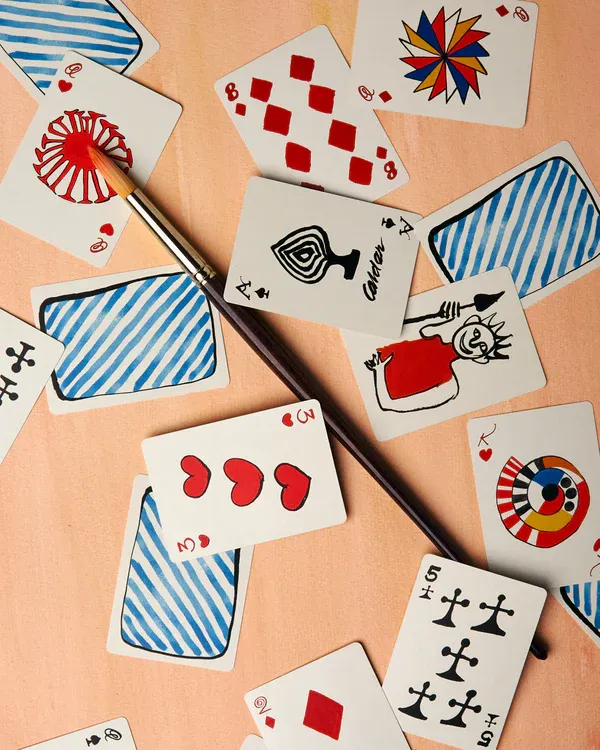
Playing cards remain one of design's most enduring canvases. Theory11, the New York outfit favored by David Copperfield and Jimmy Fallon, makes over a hundred luxury decks—the gold-foiled Monarchs and licensed runs for Star Wars, SNL, and Neil Patrick Harris—with the Artisans deck printed on FSC-certified paper using vegetable-based inks. Art of Play, the Brooklyn shop founded by Dan and Dave Buck, sells hand-painted transformation decks (the William Stout-illustrated Fantasy deck reimagines all 54 cards as fantastical beasts) and hides a 26-seat close-up magic theatre behind the storefront. 52Kards has been quietly publishing free magic and cardistry tutorials since 2011, alongside a curated shop of working-magician favorites. And once the collection's assembled, Ash Ryan and C.S. Kaiser's Best of Classic Card Games covers 80 games searchable by name or player count—Canasta to almost-forgotten historical games—with diagrams of every layout, so nobody has to bluff through the rules.
The Critmaker Guide to Dice Craft: The Ultimate Dice Making Guide
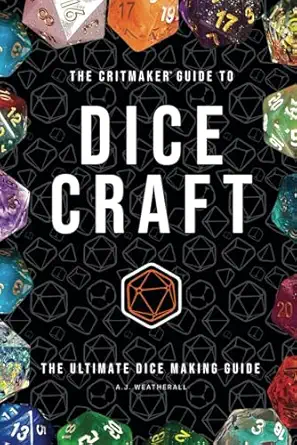
A.J. Weatherall—better known online as Critmaker—has written the field manual for a growing subculture of hobbyists pouring resin into tiny polyhedral molds at the kitchen table. The Critmaker Guide to Dice Craft distills over a year of research, testing, and conversations with top dice-making professionals into step-by-step instructions for handmade D&D and Warhammer dice: which resins, molds, and polishes to buy, how to navigate "the honey zone" of pour timing, and when to graduate to pressure pots, vibratory tumblers, and ultrasonic cleaners. Scattered throughout are artist spotlights of petri dice, inclusions, and stained glass work that read like a gallery catalog for tabletop nerds. Level up game night or start a side hustle; either way, this is where to begin.
Galton Board: Simple Probability Demonstrator
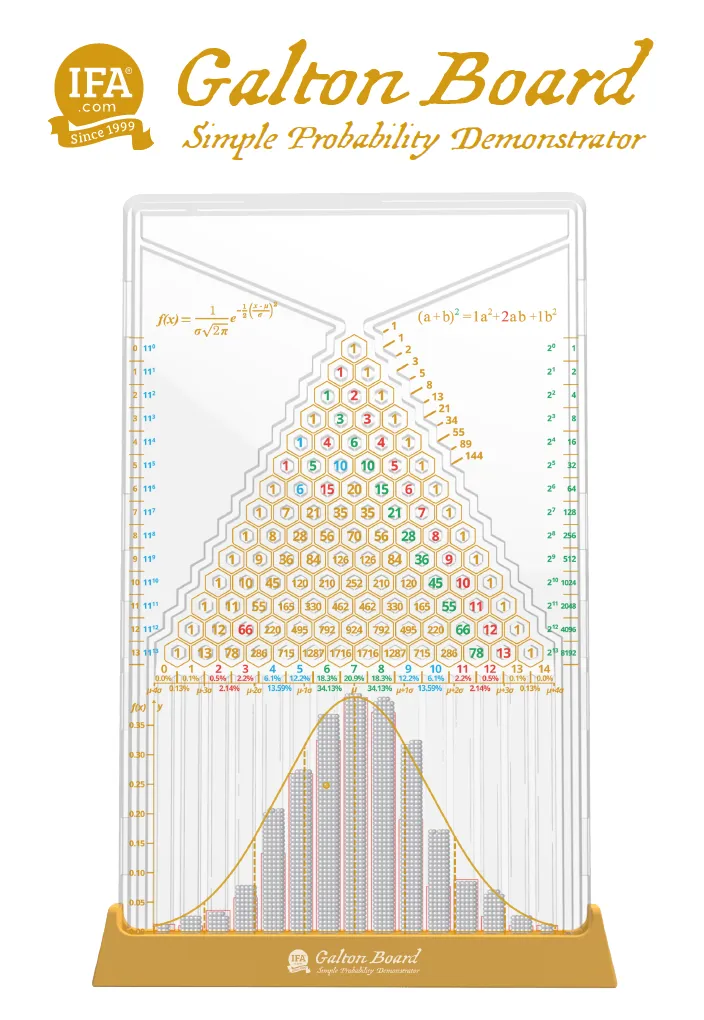
Francis Galton was so transfixed by randomness producing order that in his 1889 book Natural Inheritance, he wrote the resulting bell curve "would have been personified by the Greeks and deified, if they had known of it." His desktop demonstration — a board of staggered pegs through which steel balls cascade, each peg sending its ball left or right at fifty-fifty odds — always lands them in a tidy normal distribution at the bottom. The Four Pines Publishing version packs 3,000 steel balls and 12 branching levels into a flip-over acrylic shell, with Pascal's triangle overlaid on the pins so the math is visible alongside the physics. Tip it, watch chaos resolve into a bell curve, feel briefly smarter. Charles and Ray Eames built monumental versions for museum lobbies, this one fits on your desk.
Ship, Captain, Crew
Ship, Captain, Crew is one of those games that lives on in pubs and on cruise ships and around late-night kitchen tables, with regional variations and house rules that change as you cross state lines. It’s pretty simple. You need five dice and at least one willing opponent.
The goal of each turn is to roll, in order, a six (the ship), a five (the captain), and a four (the crew), and then to score as high as possible with the two dice you have left. Those leftover two are your cargo, and their sum is your score for the round. The order matters. You have three rolls per turn, and on any roll you may set aside dice you want to keep — but you cannot keep a five until you have a ship, and you cannot keep a four until you also have a captain. Ship, then captain, then crew, in strict sequence. Once all three are off to the side, whatever you roll on your remaining two dice becomes your cargo. If your third roll comes up and you still don't have the full ship-captain-crew, you score nothing for the round.
Here’s an example turn. First roll, five dice: 6, 3, 5, 2, 1. You keep the six. The five doesn't count yet — the captain can't board before the ship is set aside. Second roll, four dice: 5, 4, 4, 2. Now the five counts. Keep it. One of the fours counts too. Keep that as well, and reroll the rest. Third roll, two dice: 3, 6. Cargo of nine. That's your score. The maximum possible cargo is twelve, double sixes. Each player takes a turn per round; the player with the highest cargo wins. Play to whatever number of rounds you have agreed on — five is traditional. Most rounds win the game.
The traditional pub version adds a betting layer if you want to sharpen the stakes. Everyone starts with a stack of chips and antes one into a pot before each round. The highest cargo takes the pot. Ties split it, or trigger a sudden-death roll-off, depending on the table. Some houses have extra rules on top of the others. A cargo of seven — the statistical average for two dice — costs the unlucky roller an extra chip. A cargo of twelve doubles the pot. These add a little drama without altering the game's basic shape. The chips are mostly there to give you something to lose, which, in the absence of any actual skill, turns out to matter more than you'd think.
The Chasm
Here is a simpler dice game one we cooked up for Galaxy Q. It plays solo or with as many people as you like. We call it the Chasm. You'll need a pair of ordinary dice and something to keep score on. Each player starts with twenty health. A turn is one roll of both dice. Subtract the smaller from the larger and take that number off your total — the gap between the dice is the damage you take. A roll of six and one costs you five. A roll of four and three costs you one. Doubles work differently. Roll a matching pair, and you heal instead, gaining health equal to half the face value of one die.
Double fours give you two health back. Double sixes give you three. If you’re playing solo, you keep rolling until you hit zero. Your score is the number of rounds you survived before the chasm took you. With more than one player, take turns rolling, track your own health on paper, and the last player still above zero wins.