
Botanicals
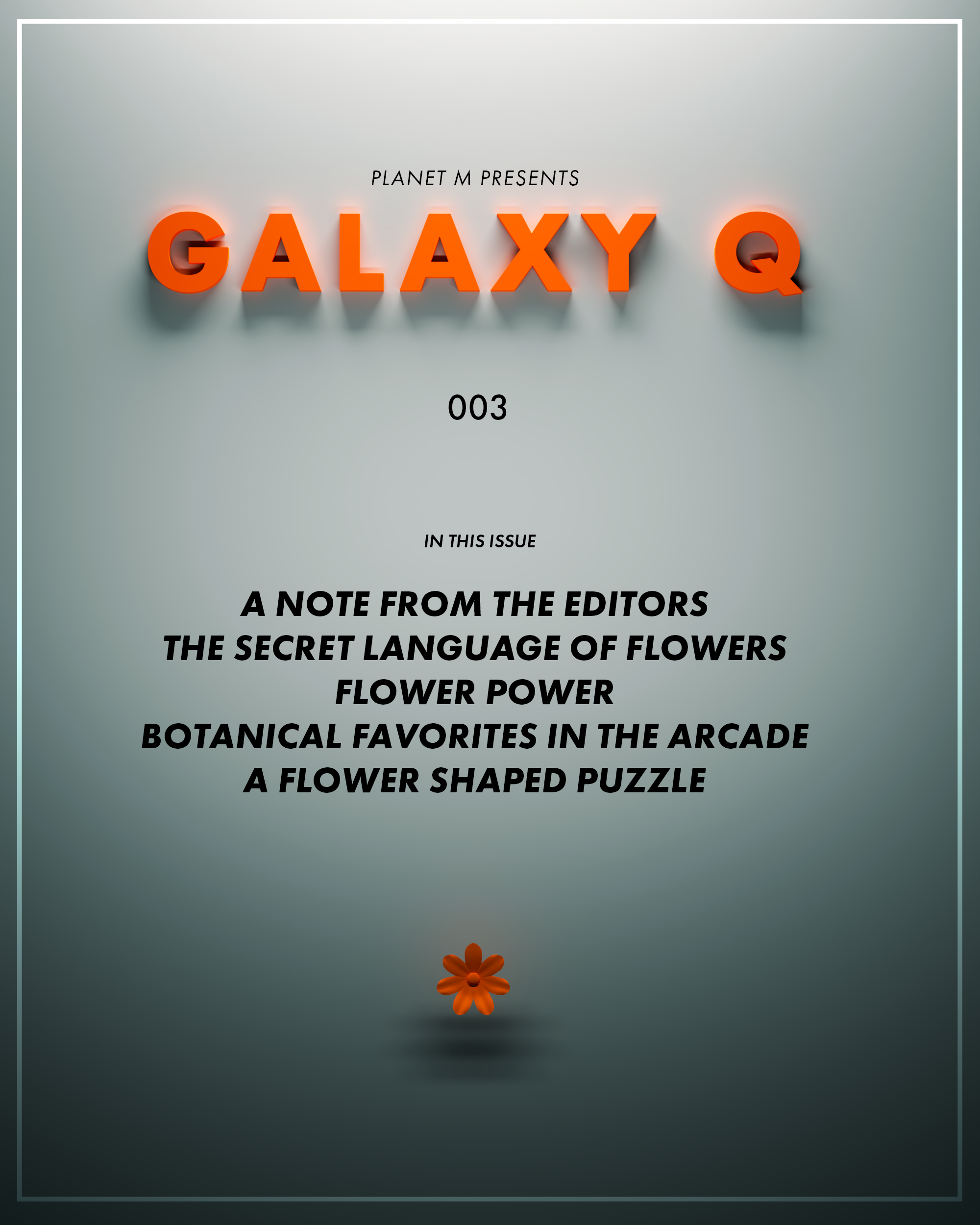
Do April showers really bring May flowers? Find out in Galaxy Q #003.
Howdy.
This is Galaxy Q #003.
As the Northern Hemisphere tilts back toward the sun, as we say goodbye to winter and hello to spring and hello to warmer weather and hello to longer days and … hello to flowers. We hear that April showers will bring them to us in May, so we thought we’d prepare as only we at Planet M can* — with a botanical-themed Galaxy Q edition.
In the A block, we reveal the secret language of plants and their ancient history as living code books for spies, lovers, and even the Gods. In the B block, we survey the evolution of the most powerful botanical in the universe: the Super Mario fire flower. In the Arcade we’ve got magic markers for your garden, sustainable pots that some of us have in our homes right this very moment, and also one of our favorite art/bts/video game books ever.
Finally, we wrap it all up with a flower-shaped crossword that we’ve heard is about a “Wednesday” on the New York Times Difficulty Scale(TM). Current record is 9 minutes 7 seconds. Answer key available here.
That’s all for the moment. We hope you enjoy the third issue of Galaxy Q. Just don’t forget to stop and smell the flowers.
With love,
The Editors
\* the producers of The Great British Bakeoff also love a good botanical theme, and for that we salute them. Cheers!

The Secret Lives of Flowers and Plants
From Victorian love notes to quantum cryptography
by Justin McLachlan
So you’re still wasting your time with invisible ink? Well how about a secret message that can not only stand out in plain sight, but then withers and dies without anyone ever being the wiser? How about a secret message in a flower?
It worked for the ancient Persians. They were known to have developed elaborate gardens where different paths and arrangements of flowers communicated specific messages to those in the know, effectively creating a living, growing code book that could be read only by allies and confidantes. Same for the Victorians, much later. In a time when societal norms restricted open expression, especially in sensitive affairs and matters of the heart, flowers became a go-to medium for clandestine communication.
A red rose, for example, symbolized deep love — a trope some of us still hold dear today (see below) — while a yellow carnation was a sign of deep disdain. Jasmine stood for “amiability” or “cheerfulness,” according to Jessica Roux, author of Floriography: An Illustrated Guide to the Victorian Language of Flowers. She says Jasmine should be paired with Iris to show a friend you really admire their character. The Victorian’s botanical code was so intricate that entire conversations could be held through the exchange of so-called talking bouquets. The system was unreliable, though — Victorian flower dictionaries frequently contradicted each other. The same flower could mean opposite things depending on which guide you used.
Today, giving a rose is often a public (and expensive and environmentally intensive) gesture of love. You actually want as many people as possible to know that you spent a paycheck on some flowers flown across the globe in a giant refrigerator — the ostentatiousness of it is sort of the point. But the rose has real roots as a secret messenger-slash-enforcer — the exact opposite of a public display of affection — that stretch to ancient times and back. Maybe it’s the thorns? Legend has it the Romans carved roses in walls of their dining rooms to remind guests that what happened as guests in their homes stayed in their homes. Roman mythology holds that Cupid once gave a rose to the Greek god Harpocrates (aptly, the god of silence) so he’d stay quiet about some dirt he apparently had on Venus. And sub rosa, a 17th-century Latin term that means “under the rose” still pops up in a modern court documents to indicate something that was done in secret. Lawyers love Latin.
During World War II, even spies used flowers to communicate in secret. A seemingly innocent nosegay left on a doorstep could signal a safe house, or a specific flower pinned to a specific lapel could mean that it was safe to proceed with the mission, (or that danger lurked nearby, these codes had to be worked out in advance). Another flower-coded story — of more questionable provenance — comes from the then German-occupied Netherlands, where supposedly the citizens of Rotterdam put yellow flowers in their windows as a giant middle finger to the Reichskommissar Seyss-Inquart. A secret resistance cell of artists in the city bombed the Nazi-controlled population registry to help protect Jews in hiding, and the story goes that the yellow tulips were a subtle sign of solidarity. As secret messages go, this one reached its intended recipient loud and clear while the “senders” could plausibly deny any knowledge of the message all at the same time.
And today, not to be outdone, we’re taking it all to an extreme. Scientists are studying ways to adapt the alternating randomness and structure of flower growth patterns to create biomimetic, botanical-inspired encryption algorithms. Work is early — and its viability remains to be seen — but interest is growing right along with the need for quantum-safe cryptography. One promising pathway for botanical-inspired encryption is tech that can mimic flowers with iridescent properties, like Hibiscus. Iridescent colors shift when the angle of light changes, because of regular, dimensional patterns in the plant cell bodies. Similar techniques have been proposed based on butterfly wings, which also often have dual-color properties. In theory, these properties could be harnessed to design encryption schemes quantum computers can’t break, because they have a property that’s somewhat analogous to quantum superposition. We don’t advise holding your breath waiting for this tech, but it might one day grow into something useful.
But humans aren't the only ones who've figured out how to send messages through flowers. Long before the Persians laid out their coded gardens or Victorian lovers agonized over which bouquet to send, plants were already running their own communication networks — no codebooks required, and far more reliably. We just didn’t know it until recently. It turns out plants communicate with each other — secretly — through some well established mechanisms.
The most studied are volatile organic compounds (VOCs). When damaged by insects or animals, many release VOCs into the air that neighboring plants can detect and preemptively activate their own chemical defenses. One classic example is damaged sagebrush triggering defense responses in wild tobacco. Some plants even release VOCs that attract predators of their attackers — a form of indirect defense.
Below-ground networks involve mycorrhizal fungi connecting root systems of multiple plants (sometimes called the "wood wide web"). Through these fungal networks, plants can transfer carbon, nitrogen, phosphorus, and defense signals to neighbors. There's ongoing debate in the literature about how much of this transfer is actively "managed" by plants versus a byproduct of fungal self-interest, but more research might give us an answer and some day, even allow us to instantaneously transport ourselves on secret mushroom networks throughout the galaxy. We advise not holding your breath on that one, either.
But plants don’t even need the help of mushrooms to talk with each other. Roots allow chemical communication through the soil all on their own. Plants can detect and respond to chemical cues from neighboring roots, altering growth patterns based on whether neighbors are kin or strangers. And electrical signaling occurs within individual plants. Wound signals can propagate electrically through the phloem (the part of the stem where things like water travel upward), triggering systemic defense responses far from the damage site. This is functionally analogous to a nervous system, though mechanistically very different.
So plants are prolific communicators — though "communication" is doing a lot of heavy lifting here. Most of what we observe can be explained by eavesdropping on chemical cues rather than signals that evolved to inform neighbors. Plants don't need meaning. They don't need codebooks or flower dictionaries or secret resistance cells. They just release a molecule and let chemistry do the rest. Humans, on the other hand, can't help ourselves. We've spent centuries pressing meaning into petals — love, disdain, solidarity, silence. And most of the time, we don't even need to be secretive about it. A single rose on the table at dinner still says plenty. A yellow flower in the window or a single rose on the table at dinner should do just fine.

Flower Power
Since its debut in 1985's Super Mario Bros., the fire flower has been a cornerstone of Mario's arsenal. But as the game has evolved over the years, so has our favorite power up. Here’s a field guide to the super-botanicals of Super Mario.
The Ice Flower
UNCOMMON
The ice flower gives its user the power to throw balls of ice, but instead of killing the enemy it freezes them so they can be safely walked on or even thrown. In Super Mario Galaxy, the ice flower allows a player to freeze themselves and temporarily walk on water or even lava. It often shows up in icy shades of blue and white and can be found growing in games across the franchise.
The Super Flower
RARE
Replacing the fire flower in Super Mario Land and making the first appearance in decades in Super Mario Maker 2, the super flower transforms Mario into Superball Mario, giving him the power to throw deadly bouncing balls instead of rolling flames of fire. The super ball flower is distinguished by its blue, black and white appearance.
The Gold Flower
EPIC
New Super Mario Bros. 2 for Nintendo 3Ds has a gold flower that transforms Mario into a gold-variant with the ability to shoot golden fireballs. But instead of disappearing when they hit something (like with the fire and ice flowers), these fireballs burst and turn into coins if they splatter on any nearby enemies. Luigi, as is his perennial fate, gets a second-tier power — he turns to silver instead of gold.
The Arcade
Things we love.
Ecopots

Designed by the Belgium-based The Pots Company, these hand-finished pots and planters boast a natural-looking finish that adds a touch of Scandinavian style to any space, inside or out. But it's not just about looks – Ecopots are made from a unique formula that combines 80% high-quality recycled plastics and 20% recycled natural minerals. The company says this blend not only enhances durability and UV resistance, but also improves insulation.
Buy
Plant Gem’s “Garden in a Box”
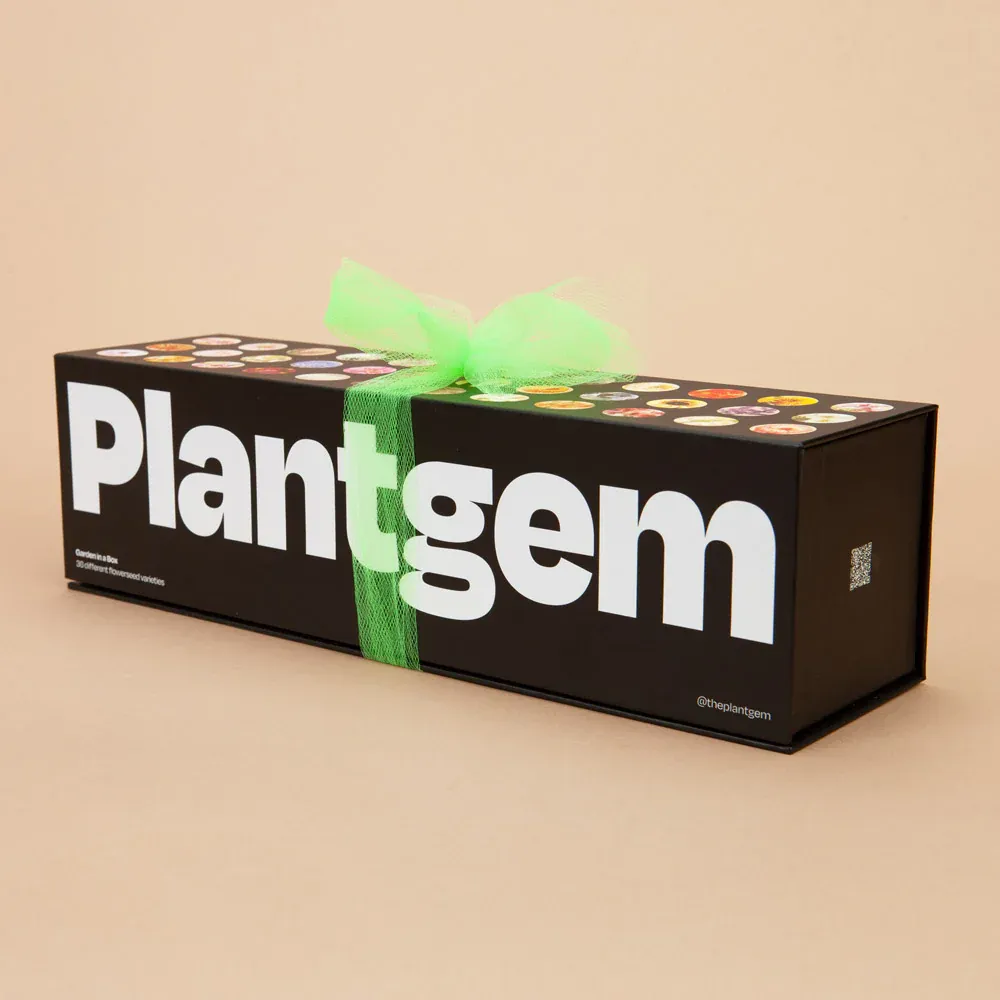
Plant Gem’s curated “Garden in a Box” is packed with 36 unique seed varieties chosen because a) they’re relatively easy to grow but b) also unique, and unusual, too. The company calls it a set of “magic markers” for your garden. Plum colored sunflowers? They’ve got that. Cosmos shaped like cup-cake wrappers? That too. Each seed packet can go straight into the ground if it’s after last frost in your area, or otherwise they can be started indoors and then moved outside when the weather’s right.
Buy
The Art of Super Mario Odyssey
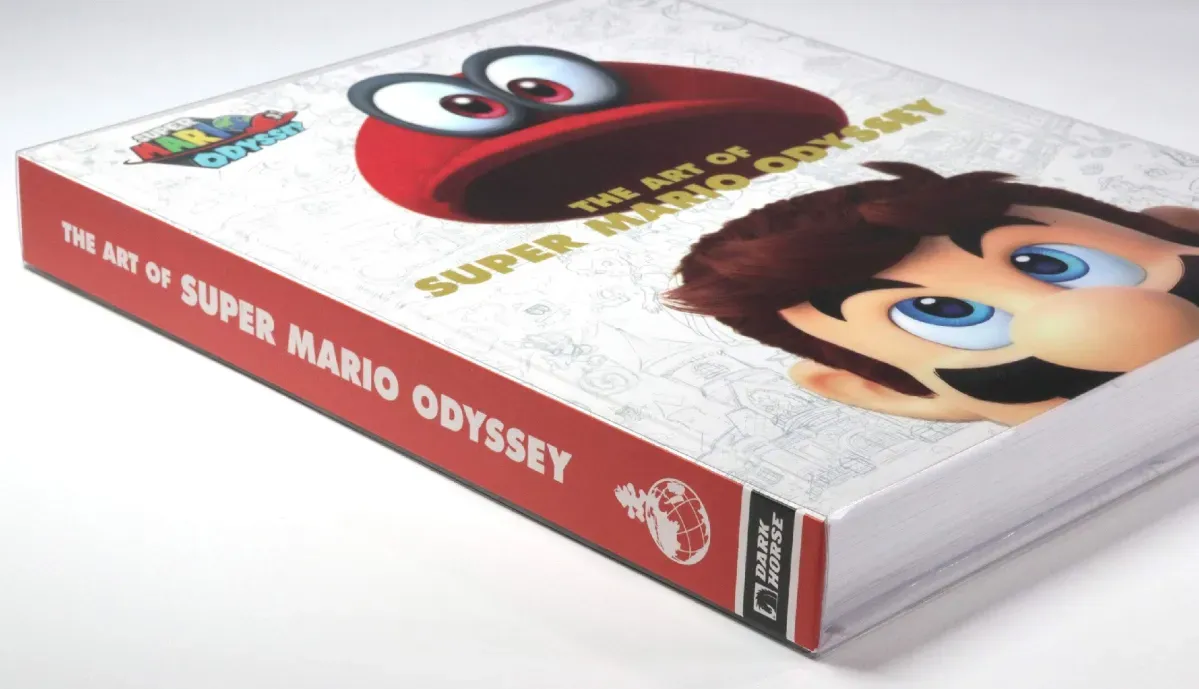
The Art of Super Mario Odyssey When you look at the hierarchy of Super Mario games, *Super Mario Odyssey* for the Nintendo Switch is near, if not at, the very top (we see you, *Super Mario 64*). Known for fluid and imaginative gameplay, *Odyssey* also stands out for a stunning, continually surprising 3D world brought to life few games before it. This full-color, hardcover book details the game's extensive development, showcasing concept art (check out the section on the fire flower), sketches, and notes from the creative team — including some ideas that didn’t make it into the game. The fire flower doesn’t get much due, but there is a sketch of a piranha-plant bouquet, so all is forgiven.
Buy
Borrow
The Square Flower Press
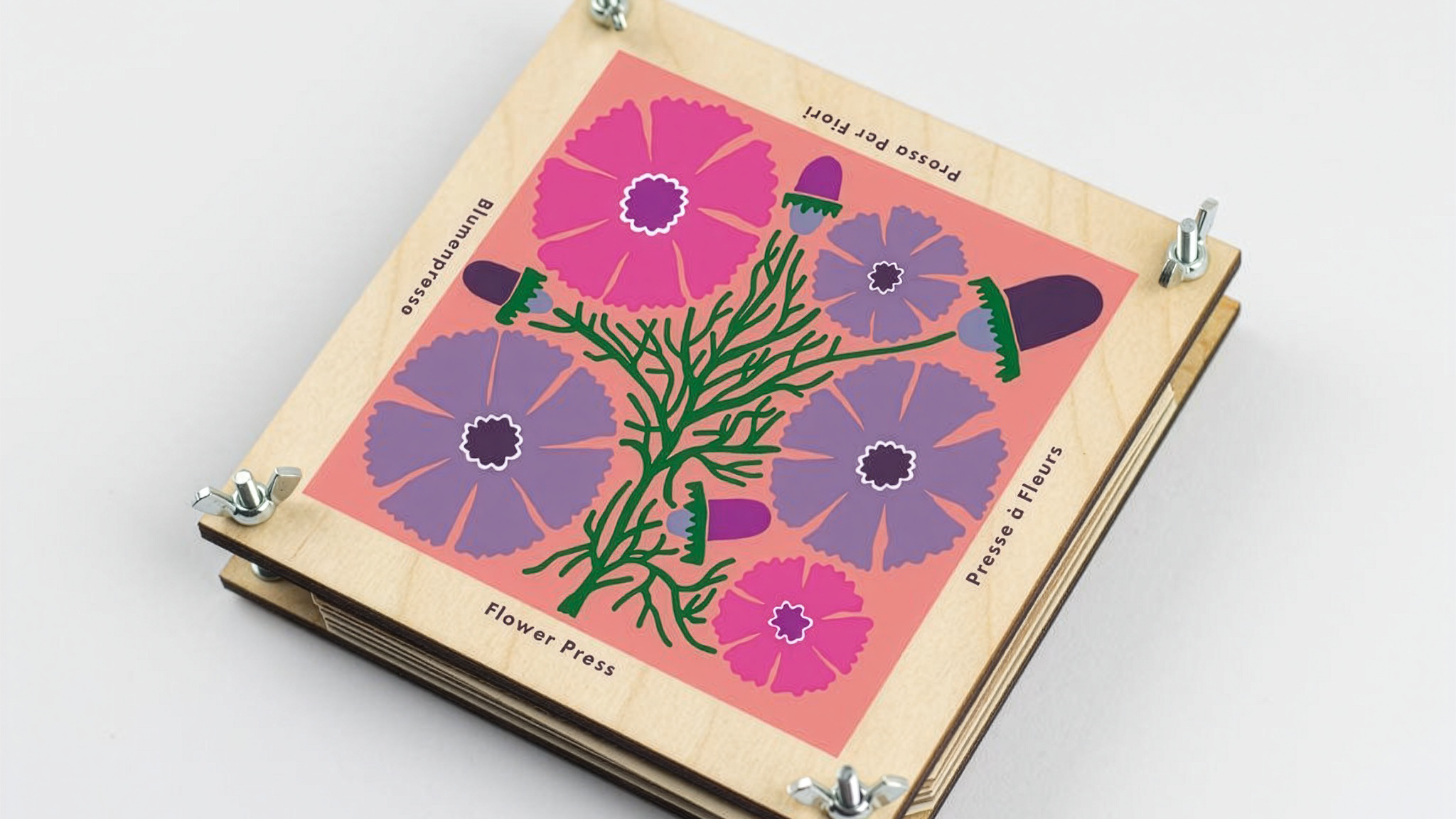
Flower pressing is one of those hobbies that we find meditative and a little addictive. The idea is simple: pick something, flatten it, wait, and you've got a preserved specimen that holds its color and shape far longer than anything left in a vase. Frame them, use them in journals, or just accumulate them the way some of us accumulate unread books — we support your decision. This press from UK-based Studio Wald is a clean, well-sized take on the classic design — corrugated card, sugar paper, nuts-and-bolts assembly — and it's portable enough to toss in a bag on your next walk.
Buy
“The solution often turns out more beautiful than the puzzle”*

| ACROSS | DOWN |
|---|---|
| 1. They may be busts | 1. Burn with hot water |
| 8. "Pipe down!" | 2. Idaho, e.g. |
| 13. Card game | 3. Anxious |
| 14. Thin, fibrous bark | 4. Most puckery |
| 15. What opposites do | 5. Red-white-and-blue inits. |
| 16. Gray | 6. List ender |
| 17. "___ we forget" | 7. Glossy gown fabric |
| 18. Oval-shaped brainiac? | 8. "All the world's a _____" |
| 20. Kenmore product | 9. Work (out) |
| 22. Bard's "before" | 10. Cause a major disturbance in |
| 23. Letters before an alias | 11. House bigwig |
| 24. Hot spot | 12. Stone Age tool |
| 26. Annoy | 19. Comprehend |
| 27. Should never | 21. Amscrayed |
| 30. Field of activity, or influence | 25. Give voice to |
| 33. Hyperbola part | 27. He took up painting while recovering from appendicitis |
| 34. Home on the range | 28. Element No. 92 |
| 36. Chinese "way" | 29. Calamity cause |
| 37. Implore | 31. Potpie morsel |
| 38. Top dog | 32. Give a hand |
| 42. Before birth | 35. "I" problem |
| 44. Sound of thunder | 37. Drunken |
| 45. Yes or no follower | 39. 1970s game with black and white stones |
| 46. What a check grabber might say | 40. Harness parts |
| 49. Some lumps | 41. Ready for anything |
| 50. Loud one | 43. Eye drop |
| 51. It may be at your fingertips | 47. Even if, briefly |
| 52. "The hostess with the ____" | 48. Call for help |
* Richard Dawkins, in Unweaving the Rainbow: Science, Delusion and the Appetite for Wonder